Fluid-structure vibroacoustic problems
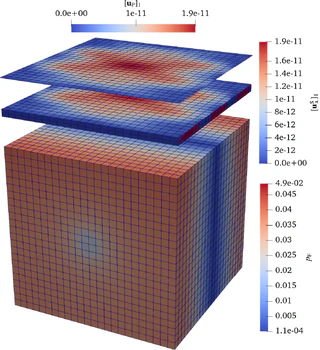 Finite element approximation of the fluid pressure field and the in-plane displacements
The present project focuses on a three-dimensional coupled problem involving a compressible fluid and a poroelastic material that is attached to an elastic plate. The Biot-Allard model describes the absorbing material's behaviour, while the elastic plate is modelled using the Naghdi model, which accounts for the transversal and in-plane structural displacements. The coupling between these three types of elements in the mechanical system increases the complexity of understanding the system's frequency response. Although a mixed pressure-displacement formulation could benefit the discretization of the poroelastic material, a displacement-displacement formulation is employed to achieve a natural coupling with respect to the degrees of freedom of the Naghdi plate displacements. Precisely, the main novelty of this work lies in addressing the coupling between the plate and the poroelastic medium using the Reissner-Mindlin formulation for the Naghdi plate model and the displacement-based formulation of the Biot-Allard model. In addition, an acoustic pressure-based model is used to describe the adiabatic compressional effects on the fluid cavity. The obtained numerical results have been compared with experimental data from two different types of absorbing materials (see figure on top).
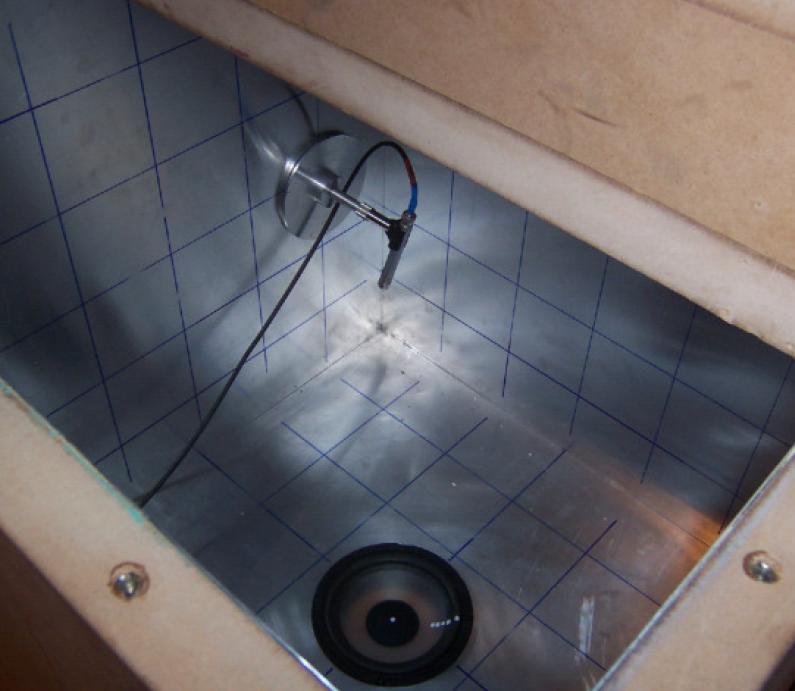 Figure 1: Experimental validation setting with a detailed view of the interior with the frontal location of the loudspeaker in the bottom.
While other studies focused on: (a) comparing numerical results with experimental outcomes for the same coupled fluid-porous-plate problem using three types of porous materials modeled through the wall impedance model, empirical model, and equivalent fluid model; (b) they have introduced the mobile wall impedance model concept. In contrast, this project addresses a direct modeling of the porous medium through Biot's approach, experimentally validating the proposed approach (see Figure 1). Furthermore, the numerical frequency responses obtained with the Biot-Allard model and the fluid-equivalent Allard-Champoux model have also been analyzed when the acoustic source is placed in a frontal or lateral location with respect to the position of the absorbing poroelastic layer. (see Chapter 3 in [1] for a detailed description of the project).
References
[1] Xabier SagartzazuContributions in the acoustic study of fluid-structure interaction problems with porous materials and thin structures
Phd thesis in mathematical modelling and numerical simulation in engineering and applied science, Universidade da Coruña, 2022. Advisor: L. M. Hervella, A. Prieto.
