Numerical characterization of coastal seabed
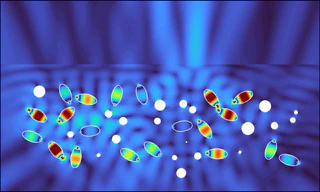 Scattering field generated by a set of bivalves buried in the seabed granular sediment
Underwater hydroacoustic measurements are widely used in sonar applications not only for detecting target objects (such as vessels or fisheries) but also to characterize the nature of the seabed and quantify the presence of algae or bivalves. However, the coastal environment usually presents challenges due to varying sediment types and hydrodynamic conditions, which can affect the accuracy of acoustic measurements (see Figure 1). Poroelastic media has been used extensively for the mathematical modelling of seabed sediments and, more recently, including specific models for granular sediments. Most of these models are based on the Biot-Stoll theory, which incorporates various parameters that affect the acoustic properties of the seabed, such as porosity, permeability, and their elastic material coefficients, which encompass the vibro-acoustic behaviour of the seabed sediment (see Figure 1).
 Figure 1: Coastal environment with the presence of bivalve shells in a sandy surface.
Under the time-harmonic assumption and since the transducer is insonifying the water column in a linear regime, the underwater coupled acoustic problem can be modelled using a linear model. This time-harmonic model involves a bilayer unbounded configuration consisting of seawater and granular seabed sediment, where the bivalves are buried. To address this complex scenario, a displacement-based Finite Element Method discretized by a Raviart-Thomas discretization has been considered. Since the original physical domain is unbounded, the computational domain must be truncated within the finite element framework. With this purpose, the Perfectly Matched Layer technique has been utilized to compute the scattering time-harmonic displacement field generated from a set of buried bivalves (see a more detailed description in [1]).
 Figure 2: Frequency response function associated to different bivalve scenarios.
Those bivalves are assumed localized in a narrow spatial domain, which reduces the computational cost of the numerical simulations. Additionally, assuming that the coupling interface between the fluid and granular media is planar, the scattering field in the seawater has been evaluated at the far field using a Green's representation formula. This approach utilizes the explicit evaluation of the fundamental solution of the Helmholtz equation in bilayer media and it allows us to compute efficiently the frequency-response function (FRF) associated with the observed intensity field values measured at the echosounder location. Thanks to the proposed approach, a variety of scenarios can be simulated in silico and evaluate numerically their associated FRF to characterize numerically the acoustic signature of a specific configuration of bivalves buried in the seabed sediment (see Figure 2).
This research line has been supported by the NumSeaHy project TED2021-131660B-I00, which is supported by MICIU/AEI/10.13039/501100011033 and the European Union Next Generation EU/PRTR. This project is also an endorsed UNESCO project (no. 42.4) of the 2021-2031 United Nations Decade of Ocean Science for Sustainable Development.
References
[1] Pablo Rubial YáñezVibroacoustic Quantification of a Coastal Seabed
Master thesis in Industrial Mathematics (2024). Advisor: A. Prieto.
